William Sabandar
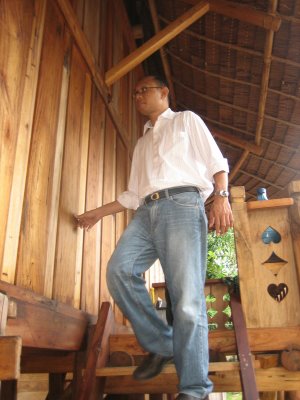 Nias good model for disaster management: Local agencyMon, 12/22/2008 11:05 AM | National The executing agency for the rehabilitation and reconstruction of Nias (BRR Nias) closed its offices in Nias and South Nias regencies Friday after spending three and a half years rebuilding the isolated Nias Island after it was devastated by the tsunami on Dec. 26, 2004, and a deadly earthquake a few months later. The Jakarta Post's Adianto P. Simamora talked with BRR Nias regional director William Sabandar about the achievements of his agency and any lingering problems that may arise in managing assets worth trillions of rupiah there following the planned exit of the BRR. Question: What lessons were learned from the rehabilitation and reconstruction of Nias? Answers: There are at least four main keys to our success in rebuilding and reconstructing Nias Island and helping local economic development. The first is trust. The central government and BRR head Kuntoro Mangkusubroto entrusted us (BRR Nias) with recovering the isolated island. This was a very important asset for us in doing our job, because it allowed BRR Nias to create initiatives to speed up reconstruction programs. With this trust, BRR Nias was able to make its own decisions including in strategic matters. We could execute our plans directly based on the urgent needs in the field. The second key is strong leadership. The government gave the BRR clear authority to reconstruct devastated Aceh and Nias. We interpreted this by simplifying the bureaucracy in the field. BRR Nias was able to respond as fast as possible on problems faced in the field. If we had to wait for normal procedures such as two-month tender processes, more people would have died because just one day of delay in assistance, and the more people will suffer. The third is good cooperation with both the central and the local governments, and the last key is the accountability report that ensured all people, including the international community and donors, knew the details of the assets built by the BRR in Nias. These four factors helped us accelerate the rehabilitation and reconstruction programs in Nias. This could be a good lesson that could be applied in managing any disasters across the country. As BRR Nias has closed its offices, could you explain a little bit about what your programs have achieved? For me, this has been a great success. I myself never imagined this before. We started from zero and practically in the first year, we were in consolidation process. But in just three years, we constructed about 20,000 houses, built about 750 kilometers of roads and rebuilt over 600 schools. We have so far handed over public assets valued at Rp 1.8 trillion. That amount does not include private assets such as houses and projects from donor countries. The first basic role of BRR Nias was to build houses and public infrastructure. However, although the BRR has closed its offices in Nias, we still have two projects valued at about Rp 680 billion that will be carried out next year. The projects will be run by the local and central governments. We are now pushing for the development of the economy in Nias. We need to improve the capacity of the local people. They still rely on BRR or donors' projects, but they are temporary income sources. We want to move further to develop the local people's economy, such as in the agriculture and tourism sectors. We have allocated Rp 200 billion as part of the multidonor fund to finance the development of a village-based economy in Nias. How do you see the readiness of the local administration and Nias people in managing the assets handed over by the BRR? I think it is impossible for the local administration to manage all the assets themselves. They need help. Therefore, the central government should help them do so. But the Nias administration also needs to study harder and open themselves wide to adopting systems applied by the BRR or donor countries in developing the region. I also hope the government can set up a mechanism after the BRR's exit to make sure coordination between the central and local governments run well. The mechanism should be as simple as possible. The mechanism could create special policies requiring the National Development Planning Agency (Bappenas) and the Home Ministry to join the local administration in managing those assets. They also need to set up a steering committee. I also hope the administration of North Sumatra province will give greater attention to the development of Nias Island after the earthquake. Could you explain your role as chief technical adviser for Myanmar's recovery from the cyclone disaster? To be honest, I have not yet received a formal task from the ASEAN office and the Indonesian government regarding the reconstruction of Myanmar after the devastating cyclone disaster. This is still under discussion. What I can share here is lessons learned during my two visits to Myanmar to help the ASEAN office map and assess the problems in the reconstruction phase there. The disaster in Myanmar is far bigger than in Aceh and Nias, so a great deal more effort is needed to reconstruct Myanmar. The problems is that the financial assistance from donor countries pledged to help Myanmar is far lower than we received in Aceh and Nias, at US$7 billion. I think there is also the matter of trust and leadership of the government in Myanmar. The country needs to build trust for the donors to come and help. The country needs to trust ASEAN to help reconstruct Myanmar. In the case of Aceh and Nias, the BRR and the government assured donors that every cent of the money would be used to help and manage the disaster areas. Nias hospital rebuild in third phase The Jakarta Post , Jakarta | Thu, 08/30/2007 1:54 PM The Jakarta Post, Jakarta The Rehabilitation and Reconstruction Agency (BRR) for Aceh and Nias said it expects to finish the third phase of the reconstruction of Gunung Sitoli Hospital by March 2008. The head of BRR's Nias office William Sabandar said the hospital, which is the only large health facility in the region, cannot yet fully serve the public. ""The condition of Gunung Sitoli hospital was never optimal, even before the 2005 earthquake hit,"" he said Wednesday. He said people in Nias usually went to Medan in North Sumatra for medical treatment because the hospital was not well equipped. ""If we want to help the Nias people, we need long-term goals, including reconstructing this hospital,"" William said. Nias is 125 kilometers west of Sumatra Island and is part of North Sumatra province. Before 2003 it was administrated as one regency, but today it has Nias and Southern Nias regencies. The 8.7 Richter scale earthquake that struck Nias on March 29, 2005 killed almost 1,000 people. The earthquake was the second biggest in the world since 1964. The US$5 million reconstruction project of the third phase is funded by the government of Japan through the Japan International Cooperation System, a non-profit foundation authorized by Japan's Ministry of Foreign Affairs. The third phase project includes the construction of wards, an intensive care unit, a pharmacy, a morgue, a laboratory, an image room and clinics. The reconstruction project is divided into four phases. In the first phase, the project was funded by the non-governmental organization MERCY Malaysia, which succeeded in building maternity and pediatric ward facilities, an administration unit and an operating room. The second phase, funded by the government of the People's Republic of China, built wards, a laundry and a kitchen. For the fourth phase, the BRR is still waiting for donors to build more clinics, an emergency room, and a rehabilitation center. ""The hospital used to have a capacity for 105 beds, but after all phases are completed, we will have 160 beds, some specialized doctors and a disaster management zone,"" said Norazama Abu Samsa, the operational head of MERCY Malaysia for Aceh-Nias. BRR has also provided scholarships for doctors and for some of the best senior high school students from Nias to continue their studies at the University of Indonesia and Gadjah Mada University in Yogyakarta. In February 2007, the agency had finished building 9,000 houses, reconstructing 200 kilometers of roads, 70 bridges and a number of irrigation networks. The island needs about 15,000 new houses and repairs to some 45,000 damaged homes and buildings. ""We're targeting to finish building 15,000 houses in 2008,"" said Mirza Keumala, BRR spokesman. Mirza said BRR will finish its duty both in Aceh and Nias next year and all projects will be transferred to the respective local administrations.( |
|
